Sky Bet vs Ladbrokes for NBA Props: A UK High-Street Comparison
 Available in US
Two of the Biggest UK Names, Two Different NBA Pictures
If you ask a hundred UK punters to name two British high-street bookmakers, Sky Bet and Ladbrokes will be on most of those lists. Their visibility in the UK sports betting space is enormous — the April 2026 PPC click share data shows Ladbrokes at 36.8% and Sky Bet at 23.85% of the UK Sports Betting paid search market. Combined, the two brands command well over half of the visible advertising activity in UK sports betting search, which makes them the most-encountered options for any UK bettor starting out.
The visibility tells you they are major players. It does not tell you what their NBA products actually look like. The two operators have meaningfully different approaches to NBA prop coverage, and the comparison surfaces choices that a UK NBA bettor needs to make consciously rather than by default.
This piece compares the two on NBA menu depth, request-a-bet structures, real pricing across common props, app experience, and the practical question of which fits which kind of UK bettor.
Sky Bet’s NBA Menu and Request-a-Bet
Sky Bet’s NBA section is competent without being ostentatious. The standard player props — points, rebounds, assists, threes, combination markets — are present on every game in the regular-season slate, with a moderate fan of alternative thresholds for each headline player. The menu depth is comparable to most mid-tier UK operators: deep enough for routine prop play, not as expansive as the largest specialised books.
The differentiating feature on Sky Bet is the Request-a-Bet system. This lets users propose specific NBA prop combinations not present on the standing menu and request a price. The system handles routine requests algorithmically — a four-leg combination of standard player props will typically get a price returned within seconds — and routes more complex or exotic requests to manual trader review. The pricing on automated requests follows similar overround logic to standing markets; the pricing on manual requests is often slightly more conservative, reflecting trader caution on edge-case combinations.
The Request-a-Bet feature is most valuable for bettors who have specific multi-leg combinations in mind that do not appear on the standing builder menu. It is not particularly valuable as a price-shopping tool — automated request prices typically match or modestly underperform the equivalent multi-leg builder pricing on the same legs. Where it adds value is in coverage breadth: requests on specific combinations of players or stat lines that the standing builder does not offer get genuine new market access rather than just alternative phrasing of existing ones.
The standard Bet Builder on Sky Bet is functional and behaves similarly to most UK competitors. The pricing engine appears to apply correlation adjustments on tightly coupled legs, and the maximum leg count and minimum stake align with industry norms. The interface is slightly cleaner than on some heavier-marketed competitors.
Ladbrokes’ NBA Menu and #YourOdds
Ladbrokes’ NBA menu is broader on standing markets than Sky Bet’s. Quarter-specific player props on the headline players, exotic milestone markets, double-double and triple-double markets all appear more consistently on Ladbrokes’ standing menu than on most direct competitors. The menu depth reflects a longer-running investment in NBA-specific coverage and a broader appetite for carrying lower-volume markets.
The Ladbrokes equivalent of Request-a-Bet is the #YourOdds system, which operates on similar mechanical principles. Users can request prices on specific combinations or markets not present on the standing menu, and the system returns prices either automatically or after manual trader review. The promotional posture is louder than Sky Bet’s — #YourOdds gets featured placement in the operator’s marketing in a way that Sky Bet’s Request-a-Bet does not.
The pricing on Ladbrokes’ standing markets is competitive with the rest of the UK industry. The brand is rarely the price leader on a given prop on a given night, which is consistent with its market positioning — Ladbrokes is a major-volume primary book competing on coverage breadth and brand familiarity rather than on aggressive pricing for the price-sensitive bettor segment.
The Ladbrokes Bet Builder operates with similar logic to the rest of the Entain group’s product family. Multi-leg construction is fluid, the running price updates clearly, and correlation adjustments on tightly coupled legs are applied. The difference between the Ladbrokes builder and the Sky Bet builder is mostly cosmetic — the underlying pricing models produce closely comparable outputs on equivalent leg combinations.
Real Pricing Comparison on Common Props
On standard player props, the pricing comparison between Sky Bet and Ladbrokes is, in my experience tracking both books across two seasons, surprisingly tight on most days. The two operators sit within the same general band of overround, and the per-prop differences are typically in the second decimal place — 1.91 versus 1.92, or 1.83 versus 1.85. These differences matter cumulatively to a line shopper, but they are not large enough to make either book systematically more attractive on standard markets.
Where the comparison gets more interesting is on the second tier of markets — quarter props, milestone props, exotic combinations. Ladbrokes’ deeper menu means more markets are quoted at all, but the menu-depth advantage comes with weaker pricing on the lower-volume markets. The bettor looking for a specific exotic line will more often find it on Ladbrokes; the bettor looking for the best price on a market both operators carry will find Sky Bet competitive across both standard and second-tier coverage.
Promotional pricing scrambles the comparison meaningfully. Both operators run regular price boosts and featured promotions on NBA markets, and a boost on either side can flip the relative attractiveness of any given prop on any given night. A four-leg builder boosted from 8.0 to 11.0 is a meaningful price advantage that no underlying overround difference can overcome. The line-shopping bettor needs to check both apps on bet day rather than choosing one as the structural winner.
For a bettor running a line-shopping rotation, holding accounts at both operators is sensible. Neither is so dominant on coverage or pricing that the other is redundant, and the promotional cycles on the two are uncorrelated enough that one or the other is regularly the better value on a specific prop on a specific night.
App Experience and Notifications
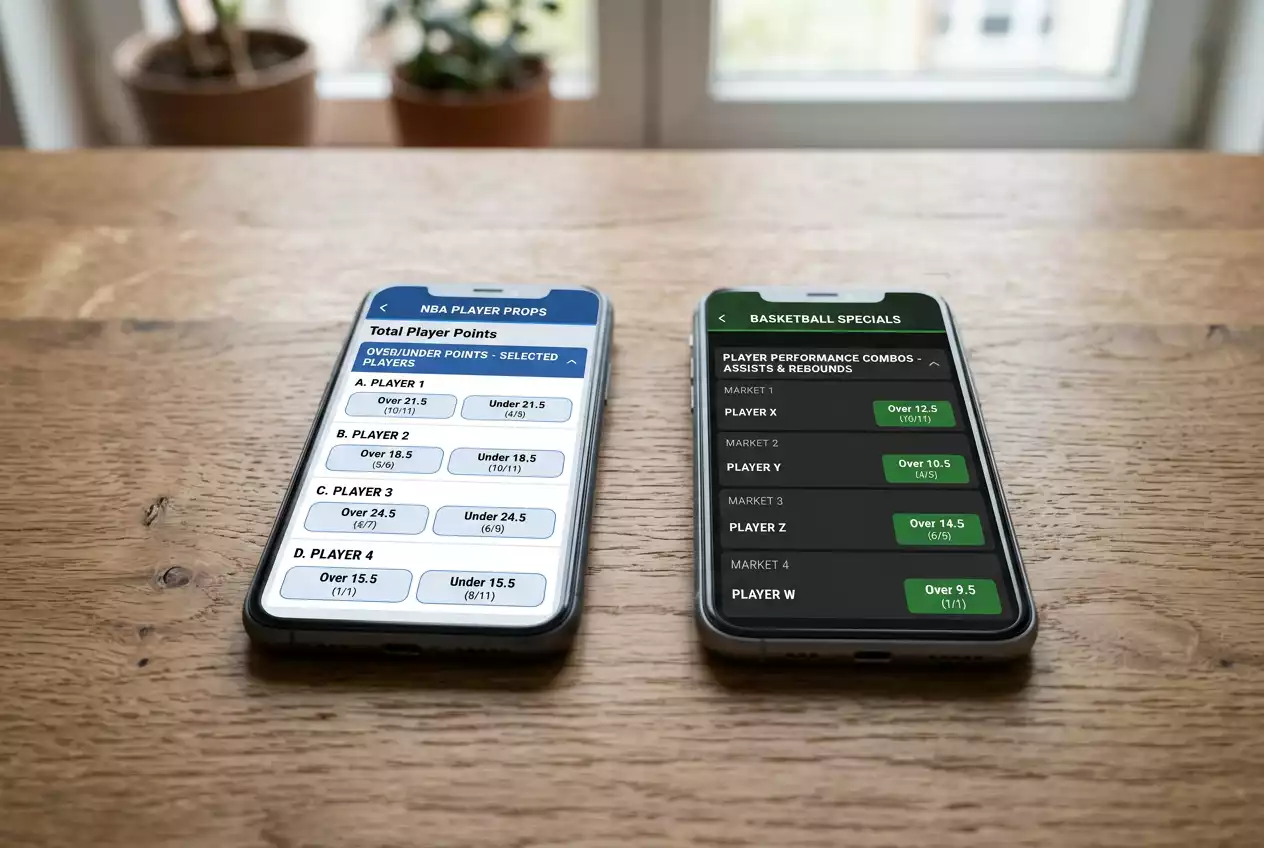
The mobile app experience is where most UK bettors spend their attention, and the comparison here surfaces the bigger differences between the two operators. Sky Bet’s app is, in my experience, cleaner and more responsive on the navigation between games and markets. The interface privileges quick switching, fast loading and minimal clutter. The visual layout is closer to what a regular news app looks like than to what a heavily-marketed sportsbook tends to push.
Ladbrokes’ app is feature-richer but heavier in the pre-tip-off pre-game flow. More promotional banners, more featured combinations, more retail-feeling integration with the broader brand. The app loads adequately on modern devices but feels denser. For bettors who like the visual energy of a busy sportsbook interface, this is a feature; for bettors who want minimal cognitive load while placing bets quickly, it is friction.
Notification systems on both apps cover the standard categories — bet placement confirmations, line moves on followed markets, settlement notifications. Sky Bet’s notification frequency is generally lower and more controllable through user settings; Ladbrokes’ is more aggressive by default and requires more user configuration to dial back. Bettors who do not want their phones lighting up with promotional alerts will find Sky Bet less effortful to manage in this respect.
Cash Out and live-betting features are present on both apps with comparable functionality. Neither operator stands out as meaningfully better on the live-game experience for NBA — both apps update fast enough, both offer Cash Out on most live wagers, both handle the usual edit and adjustment flows. The structural similarity here reflects industry-wide convergence on the live-betting feature set. The broader UK-licensed sportsbook landscape includes both as core options for any UK NBA bettor’s rotation.
Which has the deeper NBA player props menu day-to-day?
Ladbrokes generally has the deeper standing menu, particularly on second-tier markets like quarter-specific props, double-double and triple-double markets and exotic milestones. Sky Bet covers all the standard markets at competitive depth but tends to carry fewer of the lower-volume exotic listings on routine games. For bettors focused on standard player props, the menu-depth difference is small. For bettors who routinely play exotic markets, Ladbrokes is the more comprehensive primary.
Are request-a-bet markets fairly priced versus standard props?
On both operators, automated request-a-bet pricing typically matches or modestly underperforms equivalent standing-menu pricing on the same legs. Manual trader review on more complex requests tends to add a modest conservative margin reflecting the trader’s risk caution on edge-case combinations. Request-a-bet adds value primarily through coverage breadth — accessing combinations that do not exist on the standing menu — rather than through pricing advantage. Treat it as a market-access tool rather than a price-shopping tool.
Two Sensible Routes, One Spreadsheet to Decide
The honest comparison between Sky Bet and Ladbrokes for NBA props is that both are competent UK-licensed primary books, neither is structurally superior to the other on the dimensions that matter most to disciplined bettors, and the right answer for most rotations is to hold both. The promotional cycles, the menu-depth differences and the app-experience preferences will determine which sees more of your stake volume, but neither needs to be the only book in the rotation. The bettor who decides between them on instinct alone is making a choice that careful tracking would refine within a season; the bettor who tracks results across both for two seasons will know exactly which marginal differences matter to their own bet selection patterns.
Published by the nba Props Betting team.