GAMSTOP, Affordability Checks and RTS 12: What UK Bettors Actually Face
 Available in US
The Three Letters Every UK Bettor Should Know
The first time a UK sportsbook asked me for a bank statement to verify affordability, I had been a customer of theirs for two years. The request landed politely in my inbox, gave me thirty days to respond, and outlined exactly which documents would satisfy the check. Nothing about the experience was punishing or arbitrary, but it was an unmistakable shift in the relationship — the operator had decided I needed to demonstrate the financial capacity for my recent betting volume.
That experience is now common across UK-licensed sportsbooks. The combination of GAMSTOP, affordability checks and RTS 12 deposit-limit rules has reshaped how UK bettors interact with their books in ways most casual users do not fully understand until the rules touch them directly. The framework exists for genuine reasons — about 0.5% of the UK adult population fits the criteria for problem gambling under current measurement, which translates to several hundred thousand people whose lives the regulatory infrastructure is trying to protect.
This piece walks through how each tool actually works for an NBA bettor in 2026: GAMSTOP’s self-exclusion mechanics, the affordability check structure including thresholds and document requirements, the RTS 12 deposit-limit display rules, and how to use the protective infrastructure without unnecessary friction.
How GAMSTOP Self-Exclusion Works End to End
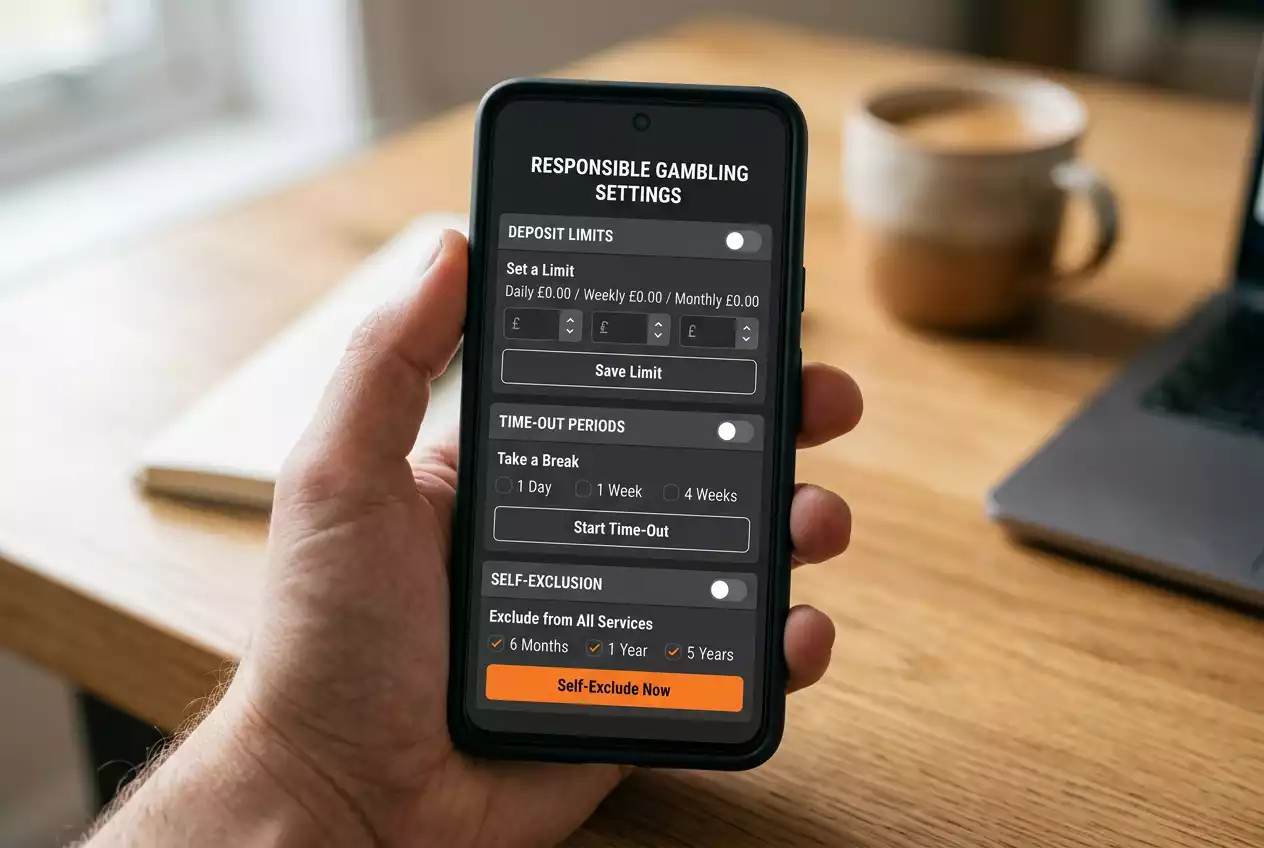
GAMSTOP is the centralised UK self-exclusion register that all UKGC-licensed operators are required to integrate with. A bettor who registers with GAMSTOP is automatically excluded from every UKGC-licensed online gambling site for the chosen exclusion period, with no need to contact each operator individually. The exclusion takes effect within 24 hours of registration and applies regardless of which UK operators the bettor was previously a customer of.
The registration process is brief — an online form covering name, date of birth, address and contact details, plus a verification step. The bettor selects an exclusion period: six months, one year, or five years. Once registered, the system propagates the exclusion across operator databases. Existing accounts on UK-licensed sportsbooks are frozen for the duration; new account creation is blocked at the verification step.
The exclusion is not reversible during its term. A bettor who chose a five-year exclusion cannot end it early by changing their mind. The deliberate friction is the point — GAMSTOP is designed to be a commitment device for bettors who want to step away from gambling for a meaningful period, and the inability to reverse the decision makes the device actually function as intended.
At the end of the chosen period, the exclusion does not automatically lapse. The bettor must actively opt out of the exclusion by contacting GAMSTOP at the conclusion of their term. This too is by design — it forces a deliberate decision to return rather than allowing a passive resumption of betting. The bettor who chose the exclusion in a moment of genuine difficulty has the option to extend rather than to find themselves automatically returned to gambling activity they may no longer want.
Existing balances at operators are typically refunded at the start of an exclusion. Withdrawals during exclusion periods follow the operator’s normal procedures with the additional verification of the GAMSTOP status. New deposits are blocked. The infrastructure is straightforward in operation; the deliberate frictions in entry and exit are the regulatory feature that distinguishes GAMSTOP from a casual deposit limit.
Affordability Checks and the £150 Threshold
Affordability checks have been the most-discussed UK gambling regulatory development of recent years. The framework is grounded in the regulator’s view that operators have a responsibility to assess whether a customer’s betting activity is consistent with their financial circumstances. The exact mechanics have evolved through several rounds of consultation.
The threshold most commonly cited in industry discussion is around £150 of net deposits in a defined window — typically a rolling 30-day period — though the precise application varies by operator and the regulatory framework continues to evolve. Below the threshold, operators conduct lighter-touch checks based on publicly available information and behavioural patterns. Above it, more substantial documentation can be requested, including bank statements, payslips or other evidence of financial capacity.
The check itself is not a credit check in the traditional sense — it is not designed to refuse customers based on their financial situation, but to verify that the customer’s gambling activity is consistent with their stated circumstances. A bettor with a modest stated income whose deposit volume implies disposable income inconsistent with that income is the case the framework is designed to catch. A bettor whose deposit volume sits comfortably within their disclosed financial profile passes through the check without further intervention.
The documentation requirements vary by operator. Some accept bank statements showing income and outflows. Some accept payslips or P60 documents. Some accept self-attestation forms for lower-threshold reviews. The general principle is that the operator needs reasonable assurance that the bettor’s betting volume is being funded from genuine disposable income rather than from borrowed money or money that should be allocated to essential outgoings.
For most NBA prop bettors operating with disciplined bankrolls, affordability checks are infrequent and largely unintrusive when they happen. The case where they become friction is when a bettor’s deposit pattern spikes suddenly without obvious context, which is exactly the case the framework was designed to identify and engage with.
RTS 12 and the New Deposit-Limit Display Rules
RTS 12 is the UKGC’s Remote Technical Standard governing financial limits — the rules that determine how operators must offer, display and operate deposit limits. The current set of rules took effect on 31 October 2025 and represented a meaningful tightening of the requirements that apply to every UK-licensed remote sportsbook.
The headline change in RTS 12 is around proactive offer and visibility of deposit limits. Operators are now required to present deposit-limit options at specific points in the customer journey — at registration, on first significant deposit activity, and at periodic prompts during ongoing customer relationships. The operator cannot simply make deposit limits available in a settings menu and wait for the customer to find them; the limits must be actively offered.
The change to the display layer is similarly substantial. Operators must show the customer’s current limits prominently in account screens, and changes to limits must be processed under specific cooling-off periods — typically a 24-hour delay between requesting an increase and the increase taking effect. Decreases to limits take effect immediately. The asymmetric processing reflects the regulator’s view that increasing capacity to gamble warrants more friction than reducing it.
The practical impact for most UK NBA bettors is more frequent reminders and clearer visibility of their own deposit limits. The bettor with no limits set who deposits £200 a month will see prompts inviting them to consider setting a monthly cap. The bettor who has set a £100 limit and tries to increase it to £200 will encounter the cooling-off delay before the new limit applies. None of this is punitive; it is friction that gives the bettor an additional moment to reflect on the change.
Using These Tools Without Losing Friction
The honest framing is that the responsible-gambling infrastructure is good for most bettors, neutral for many, and friction-free for the bettors it is least designed to constrain. The bettors most affected — those whose patterns trigger affordability requests, those whose self-imposed exclusions become live constraints — are the bettors the framework is designed to help, even when the experience in the moment can feel intrusive.
For the disciplined NBA prop bettor with a tracked bankroll and consistent staking patterns, the practical advice is to engage with the tools deliberately rather than reactively. Set a deposit limit at registration that reflects your actual bankroll plan. Use the cooling-off mechanic if you find yourself wanting to increase the limit in response to a losing run — the 24-hour delay is exactly the moment of reflection the rule is designed to provide.
The peer-reviewed research on sports betting marketing has documented its impact on younger gamblers and on those already vulnerable. The authors of one notable study described betting incentives as contributing to intensification of gambling behaviour in vulnerable populations. The responsible-gambling infrastructure is the systemic counterweight to that pressure. Using it well — setting limits that reflect your plan, taking advantage of cooling-off when emotion runs high, treating the prompts as useful information rather than as nuisances — is part of how a bettor stays inside the boundaries of healthy engagement with the activity.
The frictions are real. The deposit-limit cooling-off period is, by design, an inconvenience when you want to increase the limit. The affordability check is, by design, a request to demonstrate something. None of those frictions exists outside the UKGC framework, and the bettors who chase reduced friction by leaving the regulated perimeter discover quickly that the absence of friction was correlated with the absence of every other protection they were assuming. The 2025 UK gambling levy sits inside the same broader regulatory shift toward a healthier UK gambling environment.
How long does GAMSTOP self-exclusion last?
The bettor selects from three options at registration: six months, one year or five years. The chosen period is fixed and cannot be reversed during its term. At the end of the period the exclusion does not automatically lapse — the bettor must actively contact GAMSTOP to opt out, which is a deliberate design feature to prevent passive resumption of betting at the end of a self-imposed exclusion period.
Will an affordability check always require bank statements?
No. Many checks are conducted using publicly available data and behavioural information from the bettor’s existing operator relationship. Bank statements or other formal documentation are typically requested at higher thresholds or when other data sources do not give the operator sufficient assurance. The exact documentation requested varies by operator and by the specific reason for the check; payslips, P60 documents and self-attestation forms can also satisfy lower-threshold reviews.
A Healthier Default, Not a Punishment
The framework that GAMSTOP, affordability checks and RTS 12 collectively produce is not the gambling environment of fifteen years ago. It is more deliberate, slower at points, and more responsive to early signals of difficulty. For bettors who treat gambling as a sustainable hobby with a defined bankroll, the framework is mostly invisible and occasionally helpful. For bettors approaching the boundaries the framework is designed to protect, the friction lands exactly where it is meant to. None of this is punishment. It is the regulatory infrastructure that makes UK gambling a safer activity than it would otherwise be, and engaging with it productively is part of being a responsible UK bettor in 2026.
Written by the editors at nba Props Betting.