Micro Prop Restrictions: Which NBA Markets UK Books Quietly Pulled
 Available in US
The Quietest Story in 2025-26 Prop Betting
One Tuesday morning in November 2025 I opened a UK app to scout a Boston-Knicks game and noticed an absence. The “first basket scorer” market for Jayson Tatum was simply not there. Not greyed out, not suspended — gone. By the time I checked the same market on three other UK books, two had pulled it entirely and the third had a £20 cap on what used to be a £200-friendly listing.
Nobody announced this. There was no “we are removing markets” email. Operators do not advertise menu reductions because nobody wants to be the first to admit a market got harder to police. But the changes were everywhere if you knew where to look. This piece is what I have been able to piece together from comparing menus, reading regulator statements and talking to traders. It is a snapshot of a quiet contraction in the most granular layer of the NBA prop ecosystem.
The headline framing matters. The standard prop menu — points, rebounds, assists, threes — is intact. What changed is the bottom of the listing, the markets that depend on a single moment rather than a cumulative total. That is where the ecosystem flinched.
Markets Most Vulnerable to Manipulation
Adam Silver said it plainly on The Pat McAfee Show in October 2025 — the manipulation risk on a prop is roughly inverse to how much of the game it covers. A market on whether a player will hit thirty points across forty-eight minutes of play is hard to tilt without the result becoming obvious. A market on a single decision in a single moment is not.
That logic identifies a fairly precise list of vulnerable markets. First basket scorer sits at the top — one possession, one player, one shot. First three-pointer of the game is a close cousin. So is “team to score first” when applied at the player level, “first turnover”, “first foul drawn”, and “to score in the opening minute”. Player-specific availability props — minutes-played overs and unders, started-yes/no — sit slightly further down the risk hierarchy because they are influenced by coaching decisions as much as player conduct, but they are not exempt.
The second band of risk is a step up the cumulative scale. Quarter-specific points props, first-half rebounds, half-specific assists — these markets settle on partial-game totals where a single decision can still meaningfully tilt the outcome. A player’s first-quarter point total can be moved by whether he is on the floor for the opening minutes. That is a small enough lever for someone with inside knowledge to pull without leaving an obvious footprint.
Cumulative full-game props — which dominate any UK NBA menu — are not on the list. They reward sample size. A player chasing a points prop over forty minutes of play passes through too many decisions and matchups to be moved by a single act. That is why these markets have been left intact.
What Changed on UK Operator Menus
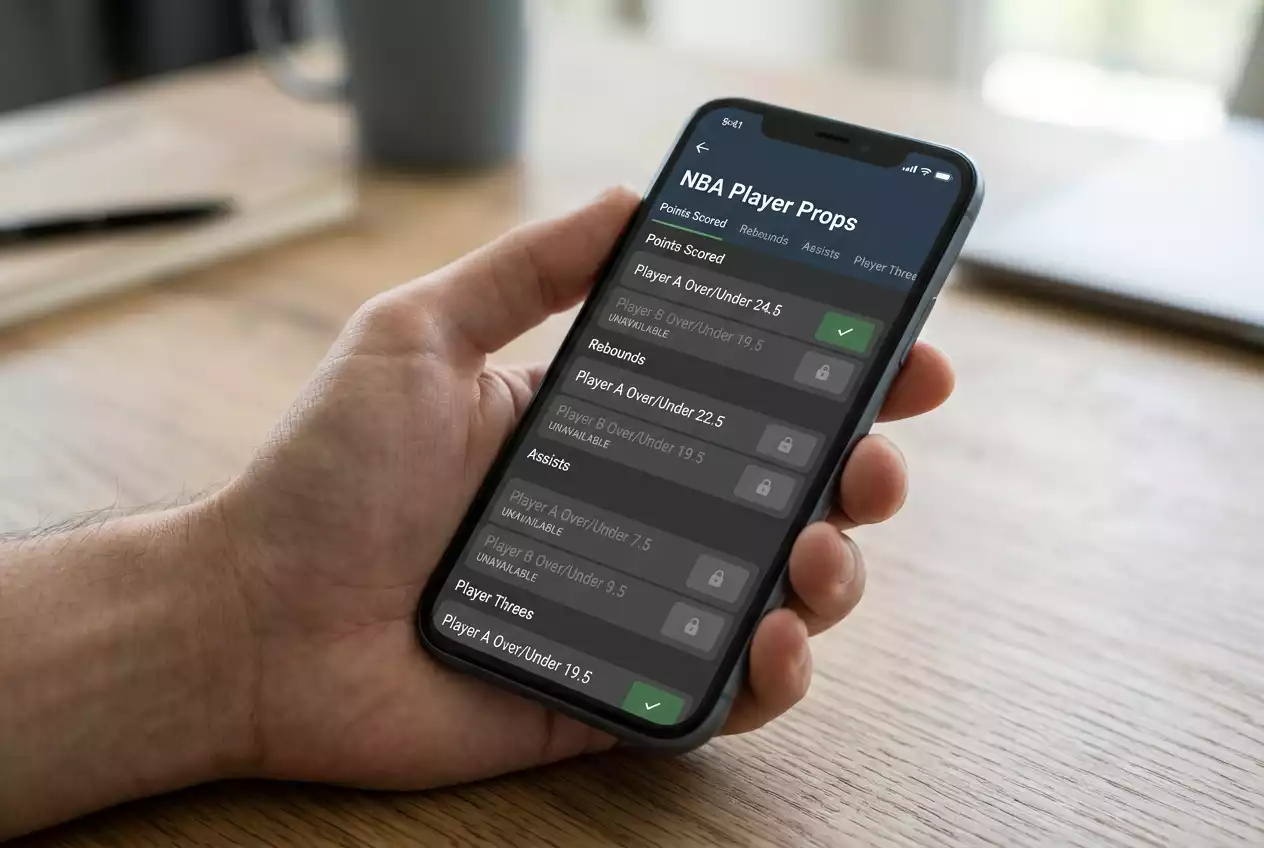
The pattern across UK books was uneven, which is itself informative. Some operators removed markets entirely. Others kept the markets but cut limits sharply. Others moved the markets to a “request a bet” or manual-quote rail rather than offering them at standing prices. The variation tells you that there was no industry directive — each book made its own integrity calculation.
First basket scorer was the most-affected market. Several large UK books pulled it from regular-season NBA listings in late October 2025. It reappeared on some menus by December, often with reduced limits and tighter risk reviews. On others it remained absent at the time of writing. Where it survived, the markets were typically restricted to a smaller pool of star-tier players where stake patterns are easier to monitor.
First three-pointer markets followed a similar arc — present on some menus, absent on others, with reduced limits across the board. Quarter-specific player markets stayed on most menus but with new “max stake” ceilings well below their pre-October levels. Started-yes/no props moved to settle-on-confirmation rules with explicit injury-risk language attached.
Same-game parlay menus felt the change indirectly. Bet builders that previously allowed first-basket props as legs lost those options on several apps, which trimmed the appeal of certain combinations bettors had built into routine. The federal case that prompted much of this conversation was the visible trigger; the menu changes were the operational response.
UKGC and Industry Pressure
Reading the UK Gambling Commission statements through 2025 was instructive. The regulator did not issue a directive to pull NBA micro-props specifically — that is not how UKGC works. What it did was push hard on two existing levers that bear directly on the economics of small markets.
The first was the statutory levy. From 6 April 2025, all UKGC licensees pay a 1.1% statutory levy on leviable revenue for remote operators, with lower rates for non-remote categories. That levy applies to every market a book offers, including the lowest-volume props. When the cost-to-offer rises and the volume on a particular market is already thin, the marginal economics of carrying that market deteriorate. The levy does not ban anything — it changes what is worth offering.
The second was the broader push on RTS 12 changes effective 31 October 2025, which tightened how operators must present and operate financial limits. RTS 12 is not specifically about NBA props, but it adds compliance overhead that lands disproportionately on books carrying the widest market depth. Combined with the integrity scrutiny that arrived after the U.S. federal cases in October 2025, the regulatory cost of running a sprawling micro-market menu went up.
The result was not a regulator-driven cull of NBA props. It was an environment in which UK operators decided, market by market, that some listings were no longer worth carrying for the volume they generated. That is a more durable form of pressure than any directive.
What a Reduced Menu Means for Recreational Bettors
For most UK NBA bettors, the menu changes are barely visible. The standard player props — points, rebounds, assists, threes, steals, blocks — are all still there. The same-game parlay menus that account for the bulk of recreational volume still build cleanly on those markets. If you log in on a Wednesday night to back a points over for a star player, nothing about your experience has changed.
What has changed is the long tail. The bettors who used to enjoy a small-stake first basket prop on every game have fewer options. The novelty markets that some bettors built routines around — first three, first turnover, first foul — appear less consistently across operators. Cap limits on what does survive mean a £100 stake is no longer accepted on markets that used to take it without flinching.
I think this is, on balance, healthy. The markets that disappeared were the ones with the worst hold-to-volume ratios for books and the worst price-to-volatility ratios for bettors. They were entertainment markets disguised as analytical ones. Their absence reduces the quantity of NBA bets a recreational bettor can place on a given night, but it concentrates the bettor’s attention on markets where information density is higher and the variance is genuinely diversifiable across a sample of bets.
The recreational bettor who never noticed the changes is the bettor who was already focused on the right markets. The bettor who cannot believe his book pulled first-basket scorer is the bettor whose menu was doing him fewer favours than he realised.
Are first-basket props still available on UK books?
Inconsistently. As of early 2026, some UK-licensed sportsbooks still offer first basket scorer markets on regular-season NBA games, often with reduced stake caps and restricted to star-tier players. Other operators removed the market entirely after October 2025 and have not restored it. Check individual operator menus on game day.
Will the micro-market trim be permanent?
It is too early to say with certainty. Some markets that were pulled returned with tighter limits within weeks. Others remain absent. The answer depends on the trajectory of integrity cases through 2026 and on how operator economics respond to the UK statutory levy. The direction of travel is toward leaner menus, not richer ones.
Trust Costs Variety, and Variety Costs Trust
The 2025-26 season showed a market in genuine self-correction. Operators trimmed their riskiest listings without being told to. Regulators raised the cost of carrying everything without singling anything out. Bettors lost a few markets they will not miss and kept the markets that actually matter to their decisions. None of that produced headlines, because nothing about it was loud. But the NBA prop menu I see when I open a UK app today is meaningfully different from the one I saw in early 2025, and the difference reflects an industry that learned something about what it could and could not safely carry.
Created by the ”nba Props Betting” editorial team.