Reading UK Fractional, Decimal and American Odds Side by Side
 Available in US
Three Notations, One Underlying Bet
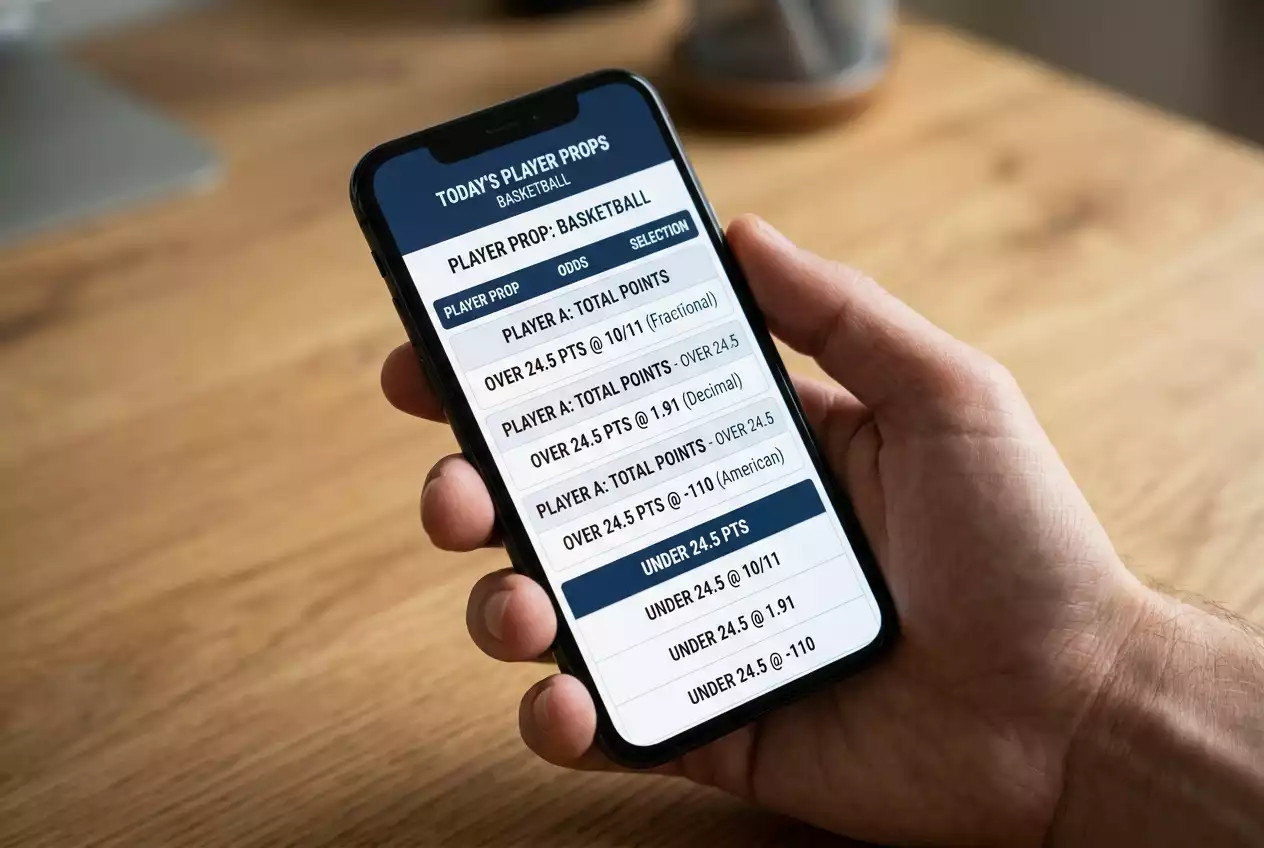
A friend asked me last week why a UK sportsbook offered him a points prop at “10/11” while his American podcast host kept calling the same bet “minus 110”. They are the same price. They look nothing alike. The third version of the same number — decimal 1.91 — is what most UK apps actually quote in their default settings, which makes the whole thing a multilingual mess for any bettor who reads American content while betting on UK books.
The reality is that odds notation is fashion as much as substance. Fractional is the British tradition. Decimal is what most of Europe and the UK industry actually uses behind the scenes. American is what U.S. operators show because that is what their bettors grew up reading. All three describe the same underlying bet — what you stake, what you win, and what the market thinks the probability is. They just dress it up in different clothes.
This piece walks through how each format works, the exact maths to convert between them, and the conversion table that most experienced bettors keep in their head for the three or four prices they see most often.
UK Fractional: 10/11, 5/6 and What They Pay
Fractional odds are the British tradition and remain the default presentation on most UK sportsbook apps unless you actively change the setting. They express the bet as a ratio of profit to stake. A price of 10/11 means you risk 11 to win 10. A price of 5/6 means you risk 6 to win 5. A price of 4/1 means you risk 1 to win 4. The first number is the profit, the second number is the stake, and the total return on a winning bet is profit plus stake.
The maths to convert fractional to implied probability is simple: divide the second number by the sum of both numbers. For 10/11, the sum is 21, and 11 divided by 21 equals 0.524 — implied probability of 52.4%. For 5/6, the sum is 11, and 6 divided by 11 equals 0.545 — implied probability of 54.5%. The number underneath is what the market thinks the chance of winning is, with the bookmaker’s margin folded in.
Fractional is intuitive at the round numbers. Even-money is 1/1, “evens” in pub terms. Three-to-one is 3/1. Twenty-to-one is 20/1. Where it gets ugly is at the odds-on prices that dominate prop betting — 10/11, 5/6, 8/13, 4/7. None of those resolve to round percentages, and most UK bettors I know quietly run them through a calculator the first few times before the patterns become familiar.
Fractional has an honest virtue worth flagging. The notation embeds the actual cash transaction more directly than any other format. If you bet 11 quid at 10/11 and win, you get 21 back — your 11 stake plus 10 profit. The arithmetic is the bet. That is why the format survives in UK culture even as the maths people prefer decimal for calculations.
Decimal Odds: The Easy Maths Format
Decimal odds express the total return per unit staked, including the stake itself. A price of 1.91 means a winning £1 bet returns £1.91 — the original £1 plus £0.91 profit. A price of 2.00 means a winning £1 bet returns £2.00, which is even-money in fractional terms. A price of 5.00 means a winning £1 bet returns £5.00, which is 4/1 in fractional terms.
The maths to convert decimal to implied probability is the simplest in the entire odds-format zoo: divide 1 by the decimal price. A decimal price of 1.91 gives 1 / 1.91, which equals 0.524 — implied probability of 52.4%. A decimal price of 2.00 gives 0.500 — even money, 50%. A decimal price of 5.00 gives 0.200 — implied probability of 20%, which is exactly what 4/1 produces in fractional terms.
This is why decimal is the format every serious bettor I know uses for actual calculation. Want to compare two prices? Compare the decimals. Want to back out the no-vig fair value? Convert each side to implied probability with one division, sum, divide, reciprocate. Want to size a Kelly stake? The b in the formula is decimal odds minus one, no fractional gymnastics required.
The single tripwire on decimal is that it includes the stake in the return, which is different from the fractional convention of profit only. A first-time bettor switching from fractional to decimal sometimes thinks 2.00 means doubling their stake on top of getting it back, which would be 4.00 in decimal terms. Once that confusion clears, decimal is the cleanest format on the market.
American: Why -110 Is Everywhere on US Sites
American odds are a two-format system pretending to be one. Negative numbers tell you how much you need to risk to win 100. Positive numbers tell you how much you win on a 100 stake. A price of -110 means you risk 110 to win 100. A price of +150 means you risk 100 to win 150. Even money is +100, which is also -100 — exactly the boundary where the two notations meet.
The maths to convert American to implied probability runs differently for each side. For a negative number, divide the absolute value by the absolute value plus 100. For -110, that is 110 / 210, which equals 0.524 — same 52.4% you got from 10/11 fractional and 1.91 decimal. For a positive number, divide 100 by the positive value plus 100. For +150, that is 100 / 250, which equals 0.400 — implied probability of 40%.
The reason American odds dominate U.S. sportsbook content is structural. The U.S. market clusters most prop and standard-bet pricing around -110, which gives the format a single recognisable centre of gravity. Every American bettor sees -110 thirty times a day, and the format anchors all comparisons against it. UK content quotes American odds frequently because most NBA betting analysis originates from U.S. sources where -110 is the default.
The format has a cosmetic awkwardness that bettors get used to but never quite forgive. A favourite at -200 is “shorter odds” than a favourite at -150, which is the opposite of how negative numbers usually work in everyday speech. The convention is that more negative means more favourite, which lines up with European conventions of lower decimal numbers meaning shorter odds. The intuition just takes practice.
A Conversion Table That Stays in Memory
Most experienced UK bettors I know carry a small mental conversion table for the prices that show up most often in NBA prop content. The most useful entries are the ones around -110, because that is where the bulk of standard prop pricing sits and that is where the break-even maths matters most. The 52.4% break-even rate at -110 is the single most-cited number in expected-value content, and it shows up identically in fractional 10/11 and decimal 1.91.
The mental table I use covers eight or nine entries. Even money sits at 1/1 fractional, decimal 2.00, American +100, implied 50%. Slightly odds-on is 10/11, decimal 1.91, American -110, implied 52.4%. More odds-on is 5/6, decimal 1.83, American -120, implied 54.5%. Heavy favourite is 1/2, decimal 1.50, American -200, implied 66.7%. Modest dog is 11/10, decimal 2.10, American +110, implied 47.6%. Bigger dog is 6/4, decimal 2.50, American +150, implied 40%. Long shot is 4/1, decimal 5.00, American +400, implied 20%.
The reason these specific entries reward memorisation is that NBA prop betting clusters around them. Standard player props sit at -110 or close. Shorter prices on heavy favourites cluster around -200. Modest underdogs sit at +110 or +120. Long-shot props — first basket scorer, exotic combinations — sit further out at +200 or +400. Knowing the implied probabilities at those clusters lets you read a menu without converting on the fly, and the no-vig framework folds in cleanly because each implied probability becomes the input for that calculation. The no-vig fair value formula takes those implied probabilities and removes the bookmaker’s margin to give you the actual fair-value picture.
The table also stays in memory because the maths is consistent. Once you have run a few conversions, the patterns repeat. Decimal is implied-probability-reciprocal. Fractional is decimal-minus-one written as a ratio. American is the cosmetic skin on top. Pick whichever format you prefer, run conversions for the rest as needed, and stop fighting the notation.
Why does most UK NBA content quote American odds?
Because most NBA betting analysis originates from U.S. sources where American odds are the native format. Podcasts, models, betting accounts and U.S. industry publications all default to American notation. UK content that draws on U.S. analysis often inherits the format. Most UK sportsbook apps let you switch the displayed format to fractional or decimal in account settings, which is the practical workaround for any bettor who finds American odds awkward.
Are decimal odds always more precise than fractional?
In practical terms, yes. Decimal can express any price to two or three decimal places without awkwardness, while fractional rounds to the nearest standard ratio. A decimal price of 1.85 has no clean fractional equivalent and gets rounded to 17/20 or 5/6 depending on the operator. The precision difference matters most on the tightly priced markets that dominate NBA props, which is why most pricing systems run on decimal internally.
Pick One, Master It, Recognise the Others
The most useful piece of advice I can offer on odds notation is the most boring one: pick the format that makes the maths feel natural to you, master it, and learn to recognise the others well enough to read foreign content without flinching. For most UK bettors, decimal is the right answer — it makes calculation easy, it dominates the actual industry pricing systems, and it converts cleanly to implied probability with one division. Fractional is fine for habit and for traditional bookmaker presentation. American is fine for reading U.S. analysis. None of them produce a different bet. They just produce a different conversation about the same bet.
Written by the editors at nba Props Betting.